
RAG, or Retrieval Augmented Generation, is used to improve the quality of responses provided by AI. It relies on internal company data that serves as a knowledge base. Specifically: before responding, the AI retrieves relevant documents from your document repositories, then generates a response grounded in your actual data.
Your teams use ChatGPT or Claude to draft emails, summarize meetings. That's great. But what happens when AI needs to respond based on your contracts, technical manuals, or HR data ? It fabricates. It cites fake articles. Or, at best, it refuses to answer.
Key Takeaways
The Problem
LLMs only know their public training data. Without a retrieval system, they cannot leverage your internal documents. With poorly organized data, they generate unusable responses.
The Solution
RAG connects generative AI to your internal document repositories. Before responding, the system retrieves relevant documents and integrates them into the context. The AI then answers using your data, with the correct references.
Tangible Benefits
Time savings on document research, error reduction, source traceability. A legal assistant cites the exact article from a contract. An HR employee finds the correct procedure in 10 seconds.
The Method
Structure your data, choose your infrastructure, connect the LLM to your knowledge base. The quality of your data determines the system's performance.
What is RAG in the context of AI?
RAG (Retrieval-Augmented Generation), is a technique that allows an AI to answer your questions by drawing on your own documents — rather than solely on its training knowledge.
) an answer based on these excerpts. The AI no longer "invents" — it reads, then responds.
[SEG SEGMENT 13]
Retrieval-Augmented Generation
works in 3 steps: 1. Vectorization (embeddings)
Your documents are transformed into numerical representations that capture their meaning. This transformation enables semantic search.
Your documents are transformed into numerical representations that capture their meaning. This transformation enables semantic search.
2. Semantic Search
When you ask a question, the system searches your document database for passages with the closest meaning. No keyword search: it understands the intent.
3. Prompt Enrichment and Generation
Relevant excerpts are injected into the LLM's context. It generates a precise, sourced answer, grounded in your real data.
Concrete Example
Question:
«How many days of remote work per week for an employee on a fixed-day contract?»
Without RAG :
The LLM responds with generalities about the Labor Code. Unsuitable for your company agreement.
With RAG :
The system queries your HR database, retrieves the company agreement and its March 2025 amendment: « 2 days maximum per week, according to article 3.2 of the telework agreement dated 15/03/2024, modified by amendment dated 10/03/2025. »
What is its purpose for Artificial Intelligence?
Without Retrieval Augmented Generation, an LLM is limited to what it learned during its training. It knows nothing about your company, your processes, or your recent data. RAG fills this gap by giving it access to your documentary assets in real-time.
80 to 90% of organizations' informational assets consist of unstructured data. It is precisely on this foundation that generative AI must be rooted.
Why deploy it for your company?
Access to internal information in real-time
Your prices change, your contracts evolve, your procedures are updated. RAG connects the LLM to your current data without retraining the model.
Source traceability
RAG cites its sources. Users can verify the information and consult the complete document. In regulated sectors, this is essential.
A reusable investment
Once your RAG infrastructure is in place, it powers multiple AI agents: HR chatbot, sales assistant, legal agent. You invest once, you leverage it everywhere.
What are its advantages?
When to use RAG?
Your EDM already contains all the answers. AI makes them accessible.
Retrieval Augmented Generation is not suitable for all applications. Three scenarios make it particularly well-suited:
How to set up a Retrieval Augmented Generation system?
Where does the knowledge come from? Not always from EDM.
Before preparing your data, ask yourself this question: where is the knowledge truly relevant to your RAG located? Three sources coexist:
Document Management
Already formalized, classified, and versioned documents: procedures, contracts, resolutions. Ready for use. This is the natural starting point.
Operational Knowledge
Your teams' business expertise, not yet documented. This knowledge needs to be captured, formalized, and integrated into the knowledge base. This involves working with operational staff.
External Reference Documents
Regulatory texts, national guides, industry classifications. To be integrated as a complementary source.
The 4 Deployment Steps
What's the difference between an LLM (Large Language Model) and RAG?
In summary: LLM = you converse. RAG = you enrich. Agent = you delegate.
What are the limitations of a Retrieval Augmented Generation system?
🟥1. Source data quality
Garbage In, Garbage Out. If your data is messy or poorly structured, RAG will retrieve bad information. Invest in structuring your documents first.
🟥2. Maintenance cost
Your data evolves. Without continuous updates, RAG will deliver outdated information. Automate as much as possible: automatic versioning, real-time synchronization.
🟥3. Technical complexity
Deploying RAG requires data engineering and system integration skills. Opt for turnkey solutions or get support from a specialized integrator.
🟥4. EDM alone is not always enough
Some critical knowledge is not yet documented; it resides within your teams. An effective RAG project often includes formalization work with operational staff to produce the examples, instructions, and best practices that will feed the AI.
Efalia helps you deploy your RAG
An effective RAG relies on well-structured data. Efalia organizes and governs your document assets so that your RAG can build upon solid foundations. EDM and RAG are complementary : one structures your data, the other intelligently leverages it.
To connect a RAG to your documents, it all starts with the storage method you use. In business, three approaches coexist. They do not offer the same level of governance, and their impacts on your RAG's performance are profound.
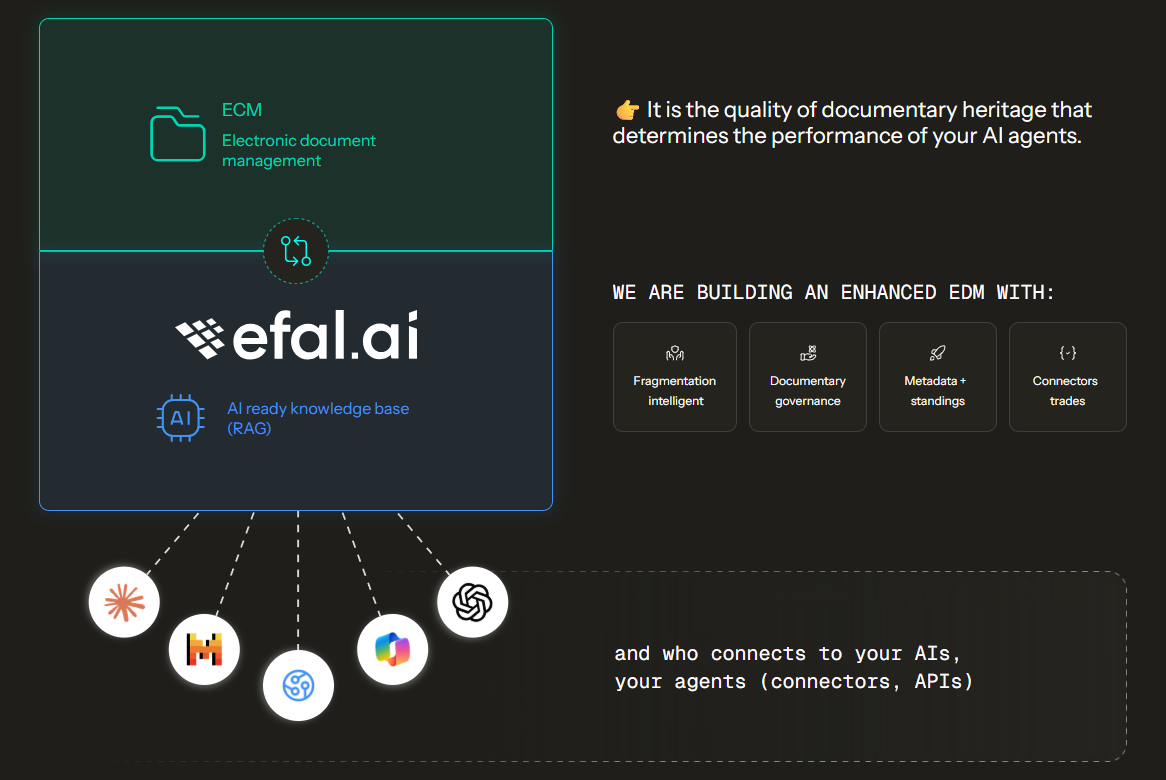
An effective RAG relies on well-structured data. Efalia organizes and governs your document assets so that your RAG can build upon solid foundations. EDM and RAG are complementary : one structures your data, the other intelligently leverages them to power your AI agents.
👉 Contact us for an audit of your document foundations