
You've decided to switch to an Electronic Content Management (ECM) system. Perfect. But before consulting providers, you need to structure your needs. A poorly defined ECM requirements document from the start leads to friction with the provider during selection — and for years afterward.
The problem? Starting from a blank slate means overlooking critical needs. Initial approximations come at a high cost. Business interfaces that break. Poorly designed workflows. Vague access rights. Good luck fixing that once the solution is in production.
AI changes the game. You can structure a personalized, complete, and ready-to-send requirements document. Here's how.
Key Takeaways
Problem: Drafting an ECM requirements document takes time. Result: structural oversights (ERP, HRIS interfaces, business workflows) and risk of technical obsolescence if AI is not anticipated.
Solution: AI-assisted method to structure your needs by business use case. Two options: AI Q&A dialogue or internal meeting transcript (45-60 min with stakeholders).
Tangible Benefits: Requirements document structured into 8 sections (functional, technical, services, AI-ready) with Word template + mega-prompt provided. No oversights regarding critical business interfaces.
Key Considerations: Anonymize sensitive data (names, contracts, amounts). Verify GDPR compliance of the LLM used. Validate with IT Director/DPO before sharing anything.
Why an AI-ready DMS requirements document changes everything
A classic DMS is about storage and search. You upload files, you find them. It works. But tomorrow, your teams will want to query their documents with an AI assistant. Extract contract clauses. Generate contextual alerts for deadlines. Cross-reference data between DMS and ERP.
If your requirements document doesn't structure these needs now, your DMS won't be ready. You'll have to go back to the "technical evolution" stage, with its associated additional costs and delays.
What is the AI-Ready option? A foundation of technical requirements that prepares your DMS for use by AI solutions: semantic extraction (RAG), interoperability with conversational agents (MCP), assisted classification, contextual alerts. You might not activate it right away, but you structure the need now.
This is the crucial point. Anticipate tomorrow's uses from the moment you write your requirements document, or pay for technical obsolescence later.
The 2 questions that structure your requirements document
Never start from a blank slate. Your current tools — SharePoint, ERP, HRIS, shared drives, email — already contain documents, habits, and pain points. Start from there.
Question 1: What is your existing document landscape?
List where your documents are today. Your invoices are in Sage. Your supplier contracts are in a shared folder. Your HR files are in an HRIS. Your delivery notes are in emails.
Identify what works and what doesn't. Examples: "Invoices are well-classified in the ERP, but PDFs remain in emails." "Contracts are scattered between SharePoint and local drives."
Question 2: Who are your users and what are their usage patterns?
Structure by "who uses what and how." Does the CFO access supplier contracts? Do managers validate documents in a workflow? Do employees consult their pay slips?
Don't list theoretical functionalities. Start from the real uses of your business teams. If you don't ask these questions now, you will structure a functional catalog that is unusable in practice.
Complete your DMS specifications in 2 methods
Two ways to speed up the drafting process. Both work. Choose the one that best suits your context.
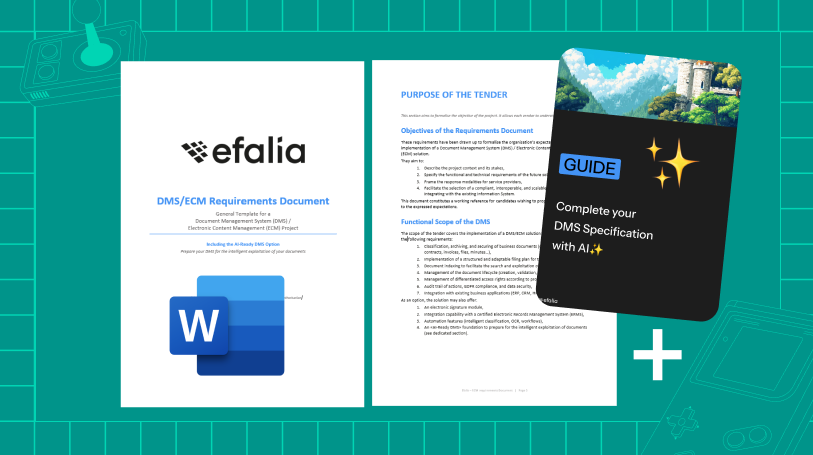
Option A : Download the Word template, open a conversation with a GDPR-compliant LLM, copy the provided mega-prompt, upload the file, and answer the questions section by section. The AI completes the document as you go.
Option B : Organize an internal meeting (45-60 min) with IT, business units, and management. You'll cover: context, existing systems, scope, volume, interfaces, security, budget/planning, and AI. Transcribe the meeting and provide the transcript to the AI, which then generates the specifications.
Both methods produce structured, personalized, and ready-to-send specifications. You choose based on your schedule constraints and team availability.
The 4 security rules before using AI
Yes, use AI for your document management specifications. But do it wisely.
☐ Rule 1: Check internal rules
Consult your Information Systems Security Policy, IT charter, IT Director/CISO, and DPO. Some organizations prohibit the use of external LLMs or mandate internal solutions.
☐ Rule 2: Choose a compliant LLM
The LLM must not learn from your conversations. Check GDPR and contractual guarantees. Prefer solutions with a contractual commitment not to reuse data.
☐ Rule 3: Activate enhanced privacy modes
Use temporary, incognito, or private modes. Manually delete your conversations after use. Don't leave any traces behind.
☐ Rule 4: Apply best practices
Work on a secure network (VPN if needed). Rephrase generically. Never copy a real document.
Practical examples:
❌ NEVER share: Client names, emails, Social Security numbers, actual contracts, deal amounts, identifiable supplier names.
✅ What you CAN share: "We are in the industrial sector", "We have 200 employees", "We manage supplier contracts worth several million euros", "We have GDPR and ISO 27001 constraints".
Anonymization example:
❌ "Our contract with Acme Corp for €2.3M"
✅ "We have supplier contracts worth several M€"
Always anonymize. Your GDPR compliance depends on it.
Your Requirements Document's 8 Key Sections
A structured ECM requirements document has 8 sections. Here's what they are and why.
These 8 sections completely structure your requirements document. The provided template details them with precise questions for each point. You answer. The AI completes. You review. It's ready.
Your requirements document, ready to send
You now have the method. Download the Word template, choose your approach (AI dialogue or meeting transcript), follow the security rules, and let the AI structure your needs.
Result: a personalized, complete ECM requirements document ready to send to providers. Ensuring no critical business interfaces are overlooked, and with an AI-ready option to anticipate future uses. And with Efalia, we're here to support you. Want to see how we compare to competitors? Check out our ECM software ranking.


.jpg)
.png)