.jpg)
HR solution interoperability means easily found, up-to-date documents, confident teams, and an HR function that gains efficiency and modernity. Let's dive into the practical details.
Key takeaways
The Challenge: HR Solution Interoperability, it's about ensuring your tools communicate automatically. This means your documents flow without re-entry, your teams save time, and your compliance is bulletproof in case of an audit.
The Solution : An HR DMS (Document Management System) which becomes the document hub for your HRIS, electronic signature, payroll, and employee portal. It synchronizes data, distributing the right documents to the right tools, automatically.
Tangible benefits: An employee created in the HRIS = automatic file in the DMS. Contract signed = automatic filing. Department change = automatic rights adjustment. Zero re-entry, zero omissions, total traceability.
How to succeed:
- Prioritize: 2-3 high-value processes (contracts, payroll, onboarding)
- Harmonize: Common HRIS-DMS data repository
- Involve: IT + HR + DPO from the outset
- Steer: Restricted scope, visible gains in 3 months
The pitfalls: Trying to connect everything at once, inconsistent repositories between tools, forgotten team training.
Reading time: 6 minutes
What "interoperability" truly means in an HR DMS
Interoperability is simple: your HR tools communicate automatically so your documents flow to the right place, at the right time, without re-entry.
What does that look like in practice?
- An employee hired in the HRIS → their file is automatically created in the document management solution (name, employee ID, department retrieved)
- Their contract generated → automatic dispatch for electronic signature
- Once signed → automatically filed and indexed in its folder
- Department change → access rights automatically adjusted
- Employee departure → file transferred to legal archiving
The result: Your DMS platform becomes an invisible yet structuring infrastructure. It ensures the compliance of your HR documents without your managers needing to intervene.
The 5 priority DMS integrations to streamline your HR processes
Connect everything at once? Unnecessary. Five connections are enough to transform your HR document management. Here's which ones, and in what order to prioritize them to ensure theinteroperability of HR solutions.
Integration prioritization table
Vision: "What about tomorrow?" HR ECM for enterprise AI
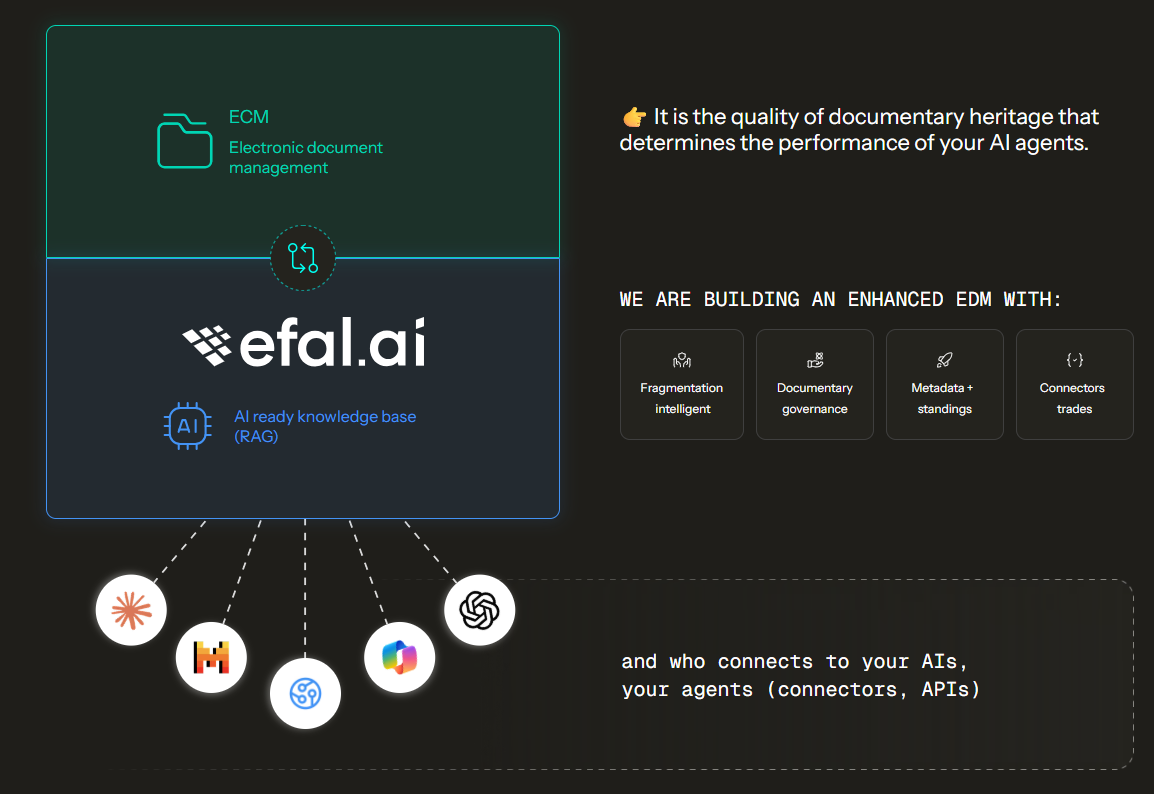
Connecting your DMS software to your HR tools is good. Preparing it for generative AI is even better. A modern document management solution integrates an MCP (Model Context Protocol) server that allows it to connect to conversational agents, Microsoft Copilot, DUST/Langchain, or the LLM architecture of your choice.
How to practically connect your ECM to your HRIS
Connecting your HR Document Management System to your HRIS isn't something you can just wing. But with a clear method, is it really that complex? Five key steps to successfully achieve HR solution interoperability.
1. Prioritize open solutions
Your DMS must have modern APIs (REST, webhooks). Ask your vendors: what native connectors do they offer? What technical documentation is available?
2. Harmonize your data repositories
Critical point: Define a common repository: naming format, unique identifiers (employee ID), document types, shared metadata (department, status, entry date). Without harmonization, you create noise, errors, and duplicates.
3. Deploy gradually
Start with high-value workflows: employment contracts, payslips, onboarding. This leads to rapidly visible benefits, validates the integration, and allows for potential adjustments.
4. Involve your IT department from the outset
Target architecture (APIs, flows, sync frequency), exchange rules (formats, protocols), security (authentication, encryption, traceability). A successful interoperability project requires HR/IT co-management.
5. Document workflows and responsibilities
Who creates? Who validates? Who classifies? Who archives? These questions may seem obvious today, but will they still be in 6 months? Document automated workflows, triggers, business/technical owners, quality controls, and anomaly management.
Essential prerequisites checklist
Technical prerequisites:
☐ DMS with REST API or standard connectors
☐ HRIS compatible with automated exchanges
☐ Standardized formats (XML, JSON, PDF/A)
Organizational prerequisites:
☐ Harmonized HRIS-DMS data repository
☐ HR document process mapping
☐ HR Business Owner + IT technical lead appointed
Security prerequisites:
☐ GDPR risk analysis completed
☐ Sensitive data flow encryption
3 automation scenarios that change everything
Scenario 1: Automated onboarding
New employee created in the HRIS → automatic file creation in the document platform. Document templates (contract, regulations, job description) generated with pre-filled data. Sent for electronic signature. Automatic classification and indexing once signed. HR portal access from Day 1. Zero paper, zero follow-ups, complete traceability.
Scenario 2: Pay slip distribution
Monthly export from the payroll tool → automatic association with the employee file in the DMS. Sent to HR portal + personal digital safe. Employee notification. At COLAS, 9 monthly HR documents are automatically processed for 35,000 employees. At the Département de l'Allier, 2,000 pay slips/month via connected DMS. Monthly processing savings, GDPR compliance, employee satisfaction.
Scenario 3: Professional appraisal management
Forms completed in HRIS/evaluation platform → automatic export to DMS, filed in employee folder. Access based on rights (managers, HR, employee). In case of an audit, how long does it take you to find all interviews for a department? With interoperability: centralized, time-stamped interviews, accessible in a few clicks.
The 4 Pitfalls to Avoid in a DMS-HRIS Integration Project
Where to start?
You now understand why and how to ensure interoperability in your HR DMS. One question remains: where to start?
Step 1: Map your current document usage.
Step 2: Identify the 2-3 high-value workflows (contracts, payroll, onboarding).
Step 3: Involve HR, IT, and DPO from the outset.
👉 Need support to launch your project? Request a demo or a free audit of your HR document ecosystem.