
Choosing a DMS is a foundational step for your company and your teams. This choice needs to be a lasting one. So, when the question arises—"are we using the right solution?"—it deserves a real answer, not a sales pitch.
OpenText is a well-known suite with a long history in enterprise content management. Many organizations rely on it heavily. However, some companies eventually find themselves re-evaluating: is the return on investment actually worth the level of usage?
This article takes an honest look at the question: which types of organizations is it truly built for, and what alternatives exist for those with different needs?
Key takeaways
- OpenText : A robust global ECM with solid document governance and native SAP and Salesforce integrations—average 4-month implementation, perceived as a "$$$$$" high-cost solution on G2.
- What Efalia Doc covers in the same scope : document management, workflows, search, regulatory lifecycle, and a right-sized, adaptable DMS.
- What Efalia Doc offers in addition :
- Structure - folder-first repository, no-code business classification plans, and 40 years of proven templates.
- Sovereignty - OVH France hosting, native GDPR compliance, on-premise options available, French software provider.
- Intelligence - AI-powered DMS (Instant / Semantic / Entity Memory), keeping you in control of your data.
Who is OpenText for? A look at a solution tailored for large enterprises
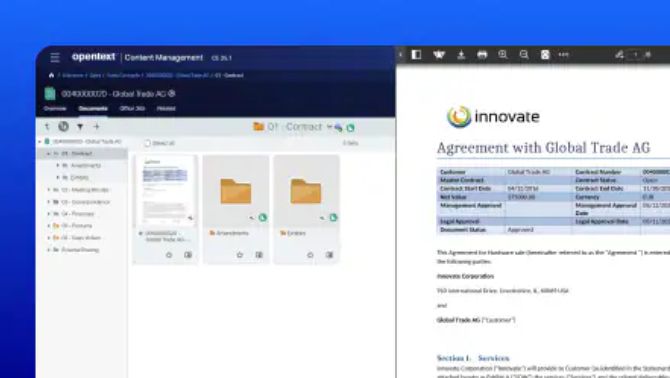
OpenText Content Manager is an Enterprise Content Management (ECM) solution designed to operate at scale. With automated classification, advanced document governance, and native integrations for SAP, Salesforce, and Microsoft, the platform covers a vast scope, and it does so with serious rigor.
G2 reviews confirm this: it holds a 4.1/5 rating, praised for its rich functionality and deep integrations. OpenText also offers an AI layer via Aviator, providing augmented content management, knowledge discovery, and explainable, auditable decision-making.
So, is OpenText suitable for every organization?
Three reasons for not choosing OpenText—or for switching away from it—come up regularly.
First, the cost: it is perceived as very high on G2, with an average ROI of 21 months.
Next, the complexity: implementation requires dedicated resources, there is a significant learning curve, and the infrastructure is heavy to maintain.
And the issue of data sovereignty: hosting and location must be confirmed based on the contract, which can be a significant factor in strict GDPR or NIS2 environments.
For a mid-market organization looking for an efficient DMS without an 18-month transformation project, this effort-to-value ratio is worth questioning.
Two visions of DMS: what the comparison really reveals
Before reading the table, one question is worth asking: are you looking for a global ECM that covers all your business processes within a large enterprise environment, or a structuring, sovereign document repository that is ready to fuel your AI without imposed complexity?
What this table says in concrete terms: regarding core functional scope, the two solutions are similar. The difference lies in three areas: activation cost, data sovereignty, and how AI integrates with the DMS.
OpenText does offer an AI layer via Aviator. Organizations evaluating it primarily note the issues of data localization and activation costs for the mid-market. Efalia Doc starts from a different principle: the AI draws directly from the structured DMS without copying data to a third-party service, with guaranteed OVH France hosting. Furthermore, the DMS is agnostic; it can be connected to YOUR LLM or the AI of your choice. It is YOUR strategy, your corporate choice.
Migrating from OpenText to Efalia Doc: what it really entails
The question of migration comes up often. And it deserves an honest answer: no, it is not trivial; but it is a well-understood process, not an unknown.
The transition is structured into three steps:
What you don't lose in the transition: your documents, your access rights, and your history. What you gain: a structured, sovereign repository that is AI-ready from day one.
Conclusion
OpenText remains a benchmark for very large enterprises that need a global ECM and have the budgets to support it. For mid-market organizations looking for a structured document management system that truly organizes knowledge, keeps it sovereign, and activates it for AI, the choice may lean toward another alternative.
Your DMS is no longer just an archiving cost. It is now the asset upon which all the value that AI can provide to you will be built.
👉 Let's see if Efalia Doc is the right fit for your situation — request a demo