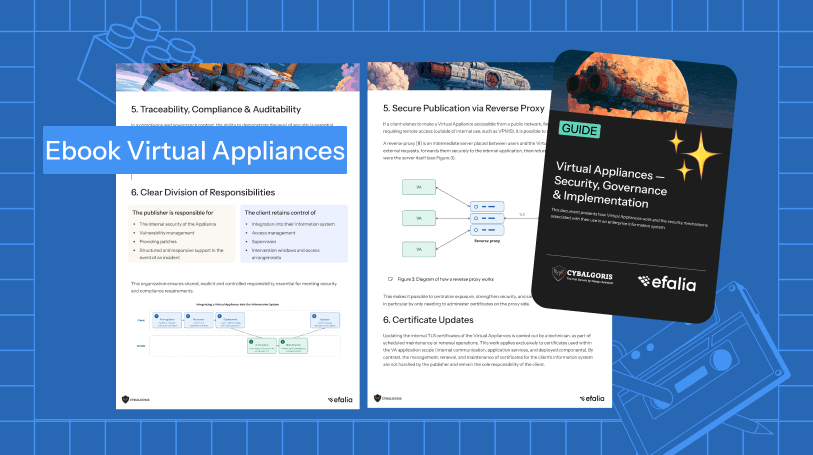
Are virtual appliances really "black boxes"? No. And this guide is here to prove it.
This is the most common misconception among security and governance teams. Yet, a properly deployed virtual appliance allows for full monitoring, traceability of all actions, and native integration into your existing tools (SIEM, EDR, SNMP). And in practical terms? Vendor technician intervention windows are generally less than an hour, using SSH access that is managed and controlled by the client.
In a context where cybersecurity, compliance, and governance requirements are constantly increasing, organizations are looking for deployment methods that can reconcile security, operational simplicity, and data control. Halfway between SaaS and on-premise, virtual appliances offer a strategic balance: an environment that is standardized and maintained by the vendor, with infrastructure and data remaining under the exclusive responsibility of the client.
Efalia, a software vendor for document platforms focused on information structuring and governance, and Cybalgoris, the leading Secure by Design assistant that secures, governs, and controls code before it reaches production, have combined their expertise to produce this comprehensive technical guide:
- Understanding Virtual Appliances : definition, operation, and positioning within the IT system
- Secure by Design Security : native hardening, CVE management, and attack surface reduction
- Transparency & Control : SIEM / EDR / SNMP monitoring, traceability, and managed access
- Implementation in the IT System : deployment, integration, and data and backup management
- TLS Certificates & Network Exposure : private CAs, reverse proxy, and renewal
- Operational FAQ : 15 key questions from technical, security, and governance teams
The result: all the tools you need to debunk misconceptions, clarify vendor/client responsibilities, and integrate your virtual appliances with complete confidence.

The first Secure by Design assistant. Cybalgoris secures, governs and controls the way software is written before it reaches production, regardless of its origin: developers, AI code generation systems or autonomous agents.