Indexing in an EDM is one of the most important functions in ensuring reliable filing, rapid research and sustainable use of documents. When well thought out, it makes it possible to find the right information in a few seconds, without re-entering and without unnecessary complexity. This article simply explains the role of indexing, its business purpose, and how Efalia addresses it in its solutions.
What is indexing in an EDM?
Operational definition and role
In a EDM tool, theindexing corresponds to the moment when a document is put away, filed in its final destination : cabinet, folder, sub-folder.
This is where he automatically receives information that describes his context: customer identifiers, serial number, last name, project identifier, part reference...
The document is therefore no longer isolated: it is integrated into a structured document tree.
Indexing vs delivery
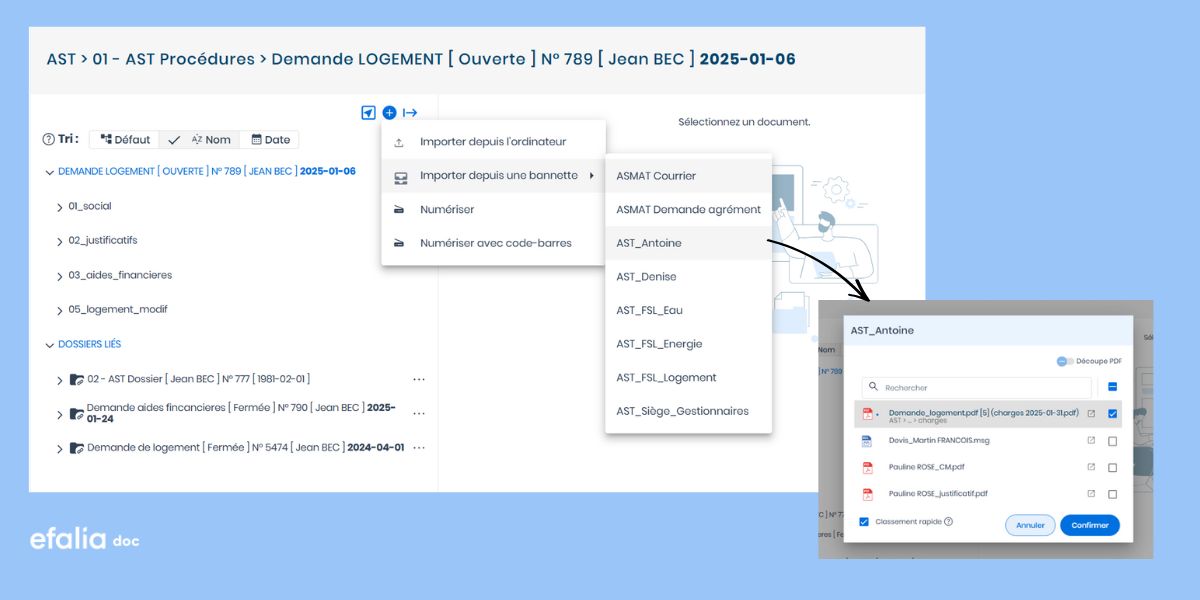
Documents can arrive in a tray: it is a temporary area, fed by the scan, email or import.
At this point there is no no indexing : the document is simply made available.
Or the documents can be scanned directly into the file.
Indexing only starts when the user files it in the correct folder.
Link to metadata
When a document is added to his file, It inherits automatically file metadata previously defined during the implementation of the filing plan. The metadata will be different depending on the type of cabinet and folders:
- customer files: customer identifiers, company name, postal code, country...
- HR files: employee data: name, first name, date of entry into the company, affiliated entity...
- beneficiary file: name of the beneficiary, date of birth, postal code,...
- project management cabinet: customer identifiers, customer name,...
- The user thus avoids any re-entry and ensures total consistency of the information.
What is the point?
Indexing is used for three major business purposes: classifying, searching, and facilitating reading.
Classification
Indexing guarantees logical and homogeneous organization.
Each document is precisely linked to its final file, so that all the elements relating to a customer, employee or beneficiary are grouped together and easily searchable. Each document is only present once in the EDM.
Good classification eliminates duplicates, limits storage errors and ensures a clear view of each file.
Research
Indexing allows you to find in a few seconds:
• a pay slip for a specific month,
• an administrative decision in the social sector,
• a customer order,
• a specific intervention room,
• a contract that is currently expiring.
Metadata is used as reference points: date, type of document, proforma number, nature of the intervention, etc.
Without them, you would have to open several documents to identify the right one, which slows down the work.
Presentation of the document
Thanks to indexing, each document has a legible identity:
type, context, membership, key information.
The user immediately understands whether it is an invoice, an amendment, a receipt or a report, without having to open the file.
It's a huge time-saver when it comes to navigating business folders.
How do I index documents in an EDM?
There are two complementary levels of indexing:
1. Indexing n° 1 — the ranking
The document is submitted in its final file.
It automatically inherits all the metadata in the file (customer, employee, beneficiary...).
Use case:
• HR employee files,
• commercial customer files,
• beneficiary files in the social sector.
2. Indexing no. 2 — complementary metadata
They refine the search:
• manual addition (example: order number, remark, part reference number...),
• semi-automatic addition: the metadata comes from entries in a business tool and is automatically uploaded to the EDM
• automatic addition via OCR or capture using additional tools.
This last possibility is feasible if the document is natively digital for a 100% compliant result. In the case of documents scanned several times, handwritten documents... the errors are numerous.
They allow accurate information to be retrieved effortlessly.
Indexing in Efalia ECM
Efalia applies a simple and operational logic:
1. The document arrives in the tray.
2. The user identifies the type of document.
3. He stores it in the right business folder.
4. The document automatically inherits the folder's metadata.
5. The classification plan then makes it possible to indicate the category: invoice, intervention, order, amendment...
6. If necessary, the user adds useful metadata (date, type, number...).
This organization is based on a principle: only ask for the metadata that is really useful.
The objective is to find quickly, without making it more difficult to enter.
Indexing to work with AI
Clean indexing prepares the ground for:
• AI-assisted research,
• automatic analysis of documents,
• automatic enrichment via OCR,
• intelligent classification.
AI works all the better when the files are clear, coherent and well-structured --> the basic principles of an efficient EDM.
This is the condition for generating reliable proposals and limiting interpretation errors.
Advice from the Efalia expert
The real question is not how much metadata can be added, but what metadata will be really useful tomorrow. When designing a filing plan, you must choose the metadata that will make it possible to find documents efficiently, without requiring teams to enter unnecessary manual entries. The balance between precision and input effort is what makes the difference between a smooth EDM and an EDM that slows down work.

EDM Project Manager at Efalia
Conclusion
Indexing is the core of EDM performance: it guarantees precise organization, efficient search and clear use of business documents.
Efalia solutions apply a user-centered approach: automate what can be automated, reduce retyping and offer a ranking plan that is easy to maintain.
If you want to understand how to optimize indexing in your organization or to see how Efalia Doc automatically structures folders, you can request a free demo.